Just Accepted
Estimation of the minimum required strength of sill mat considering crushing failure induced by wall convergence
Assessing the suitability of plastic mixed fly ash aggregates for hydraulic backfilling
Automating surface paste backfill reticulation: From routine operations to emergency response
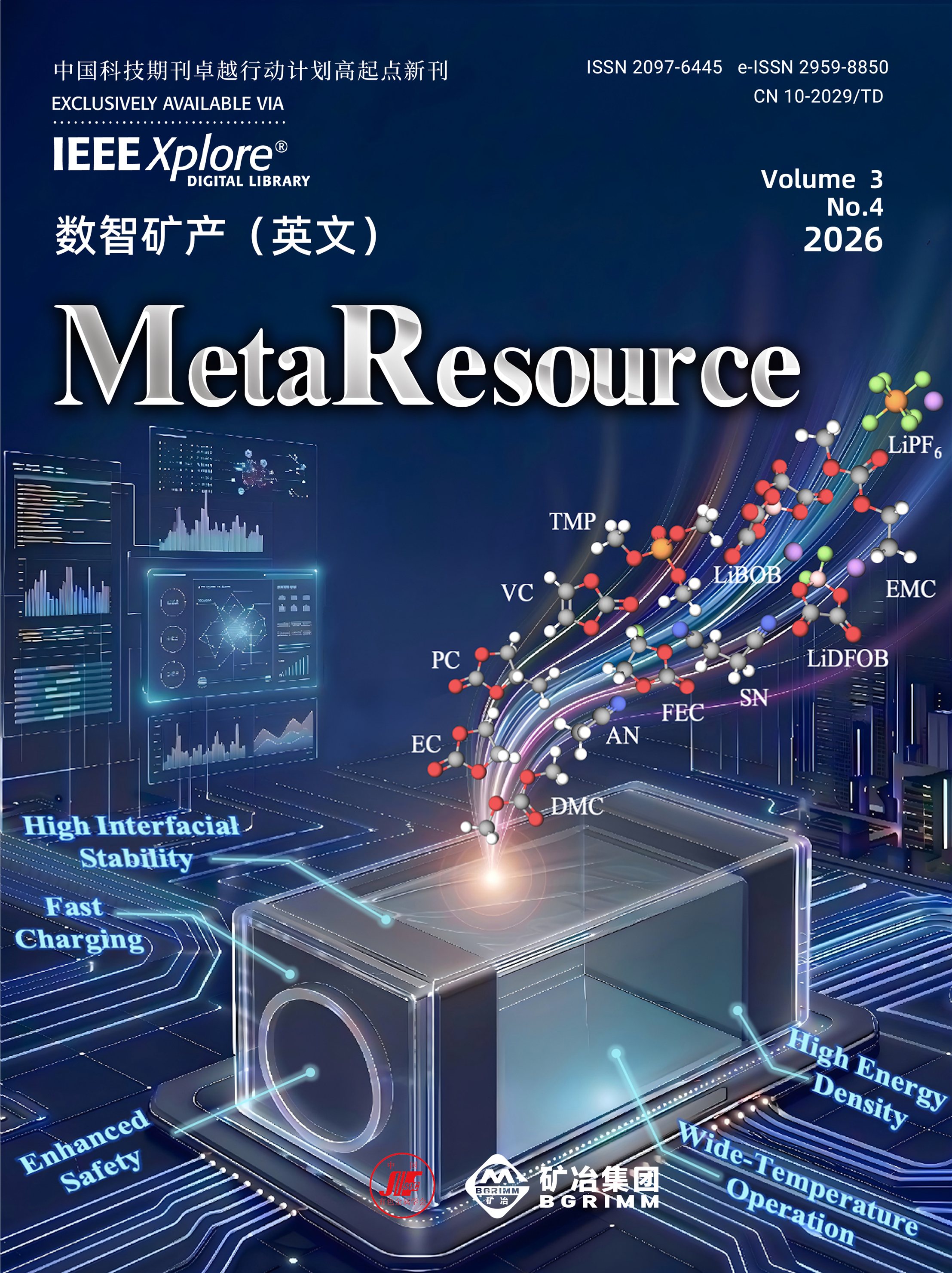
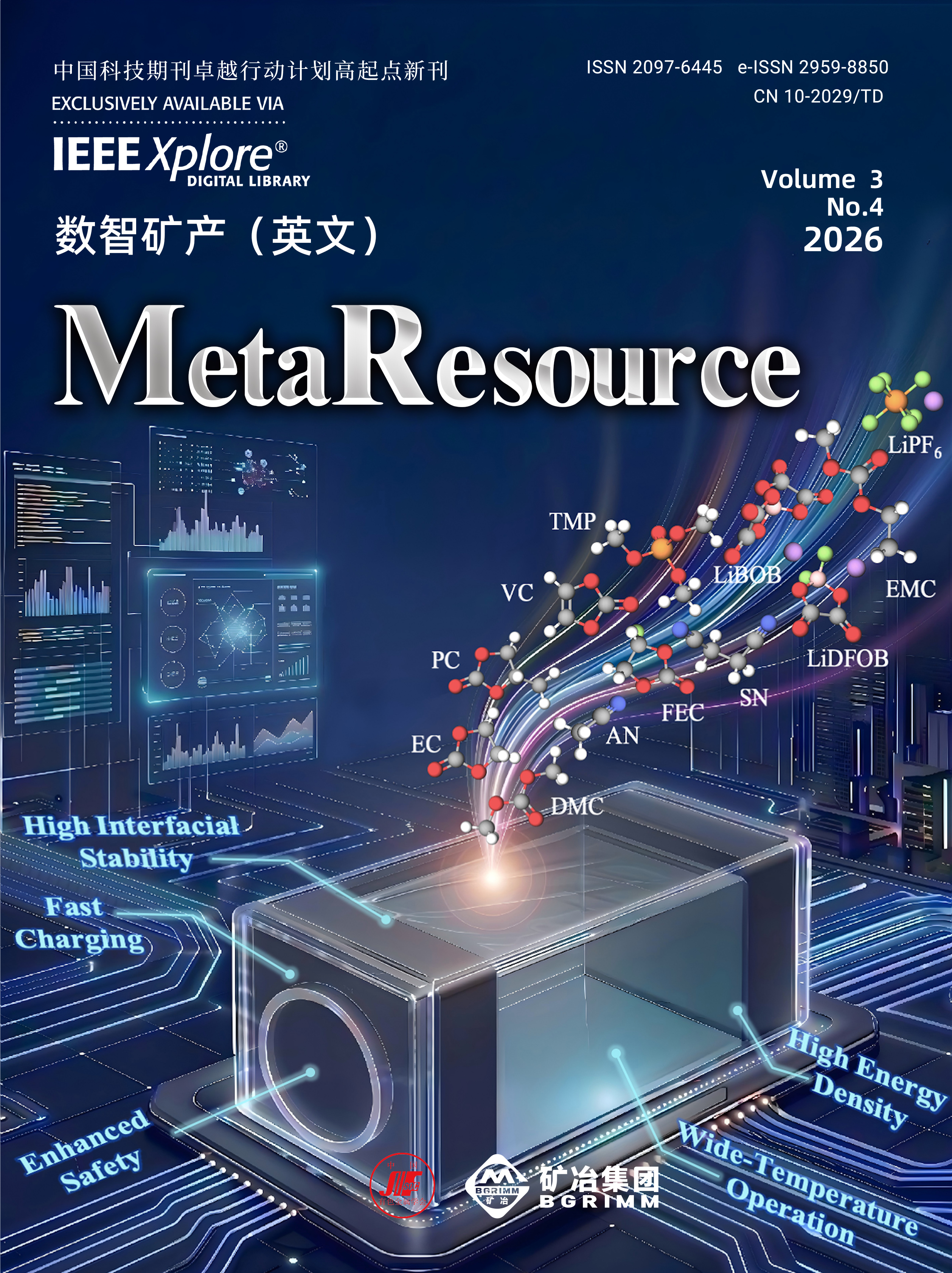
more..AI-driven analysis of electrolyte engineering for batteries
Jiawei Wu; Shiyi Zhang; Zihan Li; Shuhao Wang; Yuan Cheng; Xingguo Zhong; Yanpeng Guo; Yuejun Wang; Jian Qin; Xizheng Liu; Huiqiao LiAdvanced batteries have emerged as critical components of clean and sustainable energy systems, which have sparked extensive interest and rapid development over the past decade. The electrolyte, referred to as the “blood” of the battery, serves as the essential medium for ion transport, largely determining overall battery performance and has drawn increasing attention. This study conducts an artificial intelligence (AI)- and data-driven analysis of electrolyte engineering based on publications from 2016 to 2025, aiming to trace current research trends and emerging focuses of articles in terms of years, journals, originating countries, institutions, authors, study types, and different subject areas. By employing several refined keyword searches on battery and electrolyte in the Web of Science (WoS) Database, 75,627 articles were extracted for systematic analysis. The analysis reveals a concentrated research landscape, with lithium-based batteries, particularly lithium-ion batteries (LIBs), constituting over 60% of the selected articles. In batteries, electrolyte engineering is heavily shaped by cathode/anode materials and the imperative to solve interfacial challenges of solid electrolyte interphase (SEI)/cathode electrolyte interphase (CEI). Current research on electrolyte engineering exhibits predominantly anode-driven features; electrolytes are specifically tailored to stabilize anode/electrolyte interphase and simultaneously to meet the high-voltage stability requirements imposed by cathodes. Furthermore, a systematic analysis of different electrolyte components and their effects/drawbacks in forming stable interfaces is conducted, with the aims of designing advanced battery systems with high mechanical strength and thermal stability. Noteworthily, this work gives a clear direction, enabling the transition from trial-and-error experimentation to AI-assisted electrolyte design, and further provides “feature-to-target” guidance for the rational design of next-generation electrolytes, aiming to accelerate the development of high-performance and multifunctional battery systems.
Multi-criteria decision evaluation of coal gangue resource utilization schemes: A case study of the taigemiao mining area
Hongguang Lv; Xuegang Kang; Ling Gu; Lu Wang; Jihui Li; Liqiang MaAiming at the multi-objective and multi-criteria decision-making challenges in the process of coal gangue resource utilization, this study takes the Xinjie Taigemiao mining area as a case and proposes an integrated evaluation model combining the analytic hierarchy process (AHP) with min‑max normalization. The model is structured around the sustainable goal of coal gangue resource utilization and establishes a multi‑dimensional evaluation index system that includes technical feasibility, economic efficiency, environmental impact, resource‑use efficiency, management complexity, and social acceptability. The weights of the indicators are determined by AHP, and each alternative is quantitatively assessed using min‑max normalization, thereby achieving a systematic ranking and optimization among multiple schemes. The results indicate that low‑level grouting technology performs best in terms of resource‑use efficiency, environmental impact, and economic performance, and is identified as the optimal technical pathway for coal gangue resource utilization in this mining area. This study provides systematic and quantifiable methodological support for decision‑making in coal gangue resource utilization in mining areas, with a certain degree of universality and potential for broader application.
Time-dependent pillar performance influenced by backfill consolidation and rock creep: A numerical study
Ruo-Fan Wang; Shi-Chen Song; Hao CuiThe intervening pillar plays a significant role in ensuring safety and ore recovery efficiency during sequential stope-and-fill mining. Its mechanical behavior, however, is strongly time-dependent due to the coupled effects of rock creep and backfill consolidation, which are often overlooked in conventional design. This study presents a numerical model based on FLAC3D that explicitly incorporates these time-dependent processes to investigate pillar performance under varying stope sequencing intervals. The results show that a short interval allows the partially consolidated backfill to provide effective lateral support when the adjacent stope is excavated, enhancing pillar stability. A longer interval permits further rock creep and backfill densification, leading to significant swelling pressure on the inner side of the pillar. This induces a beam-like bending and an asymmetrical stress state including a tensile minimum principal stress in the outer part of the pillar and high differential stress with elevated brittle shear ratio in the inner portion. Results also suggest that wider pillars exhibit markedly better resistance to both tensile spalling and shear damage, whereas narrow pillars are highly susceptible to instability as the stope sequencing interval increases. The findings underscore that managing sequencing interval and optimizing appropriate pillar width are critical for mitigating time-dependent risks of pillar in multiple stope-and-fill operations.
Thermo–mechanical response and damage evolution of cemented tailings rock backfill under environmental temperature
Qifan Ren; Jianhua Hu; Hang Lin; Rugao Gao; Xiaosheng LiuThe mechanical response of cemented tailings rock backfill (CTRB) in underground mining environments is significantly affected by environmental temperature, yet the coupled effects of thermal loading and damage evolution are not fully understood. In this study, a three-dimensional meso-scale numerical model of CTRB is established using the coupled thermal–displacement analysis to investigate the influence of temperature on mechanical behaviour and internal damage evolution. The model explicitly accounts for the mechanical heterogeneity of aggregates, mortar, and the interfacial transition zone (ITZ). Specimens conditioned at different temperatures ranging from 20 to 50 °C are subjected to quasi-static uniaxial compression. The results show that (1) increasing temperature leads to a gradual reduction in peak stress and a corresponding increase in deformation capacity, while the elastic modulus is only slightly affected; (2) compared with the reference specimen without thermal coupling, temperature-conditioned specimens exhibit smoother strain distributions and higher local stress levels along internal paths, which can be attributed to thermal expansion and enhanced stress redistribution; (3) damage evolution analysis indicates a clear transition from localized damage concentration to more distributed damage patterns as temperature increases, resulting in earlier damage initiation but more gradual failure development. These findings demonstrate that the thermo–mechanical response of CTRB is governed primarily by damage evolution and stress redistribution. The coupled thermal–displacement approach is shown to be effective for capturing temperature-induced effects on CTRB behaviour.
From cut-and-fill to longhole open stoping: A case study in backfill reticulation optimisation and integrated operations management
Enya NilisTo increase annual ore production and reduce mining costs, the Black Mountain Mine (BMM) in South Africa introduced the longhole mining method. The existing hydraulic fill backfill system, designed for cut-and-fill stopes, could not cope with the new life-of-mine schedule. A backfill system upgrade project was launched to increase backfill production to enable timely filling of the longhole stopes. Analysis of the existing system identified issues related to safety, performance, reliability, and excessive downtime in the underground distribution system, the latter accounting for 47% of total system downtime. Short-term interventions addressed immediate safety and production concerns, followed by a comprehensive engineering upgrade to improve system performance. The backfill system optimisation process focused on technical improvements to the underground distribution system (UDS) using hydraulic modelling, an identification of the system’s most vulnerable components and an analysis of the dominant wear mechanisms at those locations. In parallel, backfill system utilisation was addressed and the mine prepared for longhole filling by backfill-integrated operations management which included personnel training to promote backfill system understanding and promote cross-departmental knowledge sharing. A structured approach to preventive maintenance was sought and an all-encompassing backfill management plan was created. The paper will present a comprehensive discussion of the steps and processes followed in successfully reducing system downtime and doubling the average monthly backfill production. Key learnings that can be applied to other active backfilling operations include the value of a structured approach to UDS diagnostics, the prioritisation of upgrades in accordance with the mine schedule, the need for a detailed technical understanding of hydraulic challenges, and the critical role of securing workforce buy-in to achieve and sustain backfill objectives.
Tracking the information about your manuscript
Communicate with the editorial office
Query manuscript payment status Edit officeCollecting, editing, reviewing and other affairs offices
Managing manuscripts
Managing author information and external review Expert Information Expert officeOnline Review
Online Communication with the Editorial Department
Announcement
News
Links
OA Publishing